


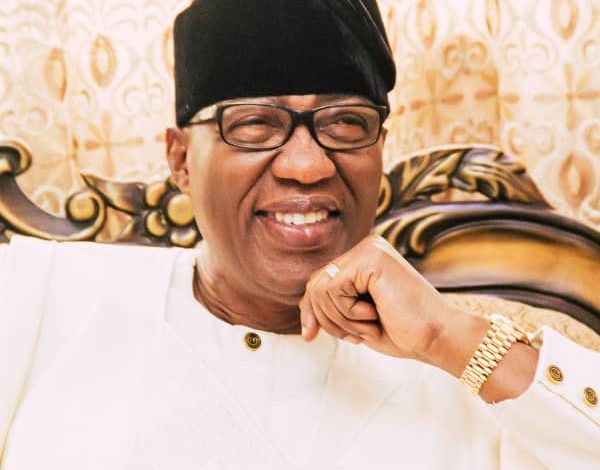
By Bunmi Alasoadura
In the political folklore of Ijebuland—where ambition often borrows the language of tradition when structure becomes inconvenient—there is a story told not as history, but as metaphor sharpened by irony.

But before the tale is told, one truth must be understood: in Ijebu cosmology and cultural life, “Orisa Ijebu” is not a roaming deity waiting to be summoned by political emotion. It is a symbolic expression of ancestral authority, cultural legitimacy, and the sacred weight of tradition anchored around institutions like the Awujale of Ijebuland, custodian of unity, order, and identity. It is the spiritual memory of a people—often expressed through festivals like Ojude Oba, not a tool for spontaneous political invocation.

With that in mind, the story begins.

The Gate That Did Not Recognize Noise

On the day of the APC caucus meeting in Ijebu-Ode, Otunba Gbenga Daniel arrived at the venue like a man walking with echoes of influence behind him—entourage trailing, confidence intact, presence unmistakable.
But the gate was not moved by presence.
It was governed by something far less emotional and far more dangerous in politics:
a list.
Accredited names only.
Controlled entry only.
No improvisation. No exception. No performance politics at the door.
Daniel was informed.
He insisted otherwise.
The gate did not argue.
It simply remained faithful to instruction.
In that moment, the political theatre of arrival met the cold discipline of structure—and structure did not flinch.
When Song Tried to Become Authority
Then came the moment that folklore exaggerates into symbolism.
Denied entry with his entourage, Daniel lifted his voice and sang:
“Orisa Ijebu wa gbe ni ja…”
In the language of political metaphor, it was not just a song—it became an attempt to summon ancestral legitimacy, to wrap political tension in cultural invocation, to turn access control into a spiritual negotiation.
But in this retelling, Orisa Ijebu did not respond.
Not because tradition is deaf.
But because tradition is not reactive.
Not because ancestry is absent.
But because ancestry is not summoned to override procedure.
The song rose—bold, emotional, defiant.
And still…
nothing answered it.
Not wind.
Not interruption.
Not reversal.
Only silence—the kind that does not insult, because it does not acknowledge the request in the first place.
Inside the Hall: Structure Speaks
While symbolism struggled outside the gate, structure was already seated inside the hall.
No drama. No hesitation. No competing soundtrack.
And then the caucus made its decision:
Prince Dapo Abiodun, CON, was endorsed by the APC caucus as the Ogun East Senatorial Candidate.
A moment delivered not with noise, but with institutional finality—the kind of decision that does not chase attention because it already carries authority.
Inside, endorsement was not negotiated. It was recorded.
Outside, however, narrative was still trying to convert denial into meaning.
But politics, unlike folklore, does not pause for interpretation.
The Meaning of “Orisa Ijebu” in the Tale
To understand the weight of the metaphor, one must understand what “Orisa Ijebu” represents in cultural memory:
It is not a spirit that takes sides.
It is not a force that attends meetings.
It is the symbolic presence of order, lineage, legitimacy, and communal structure—anchored in institutions like the Awujale’s custodianship and expressed through cultural unity at gatherings like Ojude Oba.
In other words:
It does not replace rules.
It validates continuity.
It does not bend for performance—it outlives it.
The Hard Edge of the Folktale
And so, in the political exaggeration of that day’s storytelling, a harsh metaphor emerges:
Daniel sang to bend structure.
But structure did not bend.
He called to tradition.
But tradition did not perform.
He attempted invocation.
But invocation found no shortcut.
In the folklore retelling, it is said:
Orisa Ijebu did not reject a man.
He simply refused to answer a song that tried to outrun procedure.
Not with anger.
Not with favour.
But with silence that does not argue—because it already decides.
Conclusion: The Real Payoff
In the end, the gate did not become emotional.
The hall did not become distracted.
Tradition was not recruited into confusion.
Only one reality remained standing from entrance to outcome:
structure does not respond to performance—it responds to order.
And that is where the folklore sharpens into its final sting:
Not that the song was unheard…
but that in the architecture of power, it was irrelevant.
And in Ijebuland’s political memory, that is how Orisa Ijebu is said—metaphorically—to “refuse” a song:
Not with thunder.
But with silence so complete, it turns ambition into echo.
Bunmi Alasoadura
Folklore writer and storyteller, Ijebu Igbo