


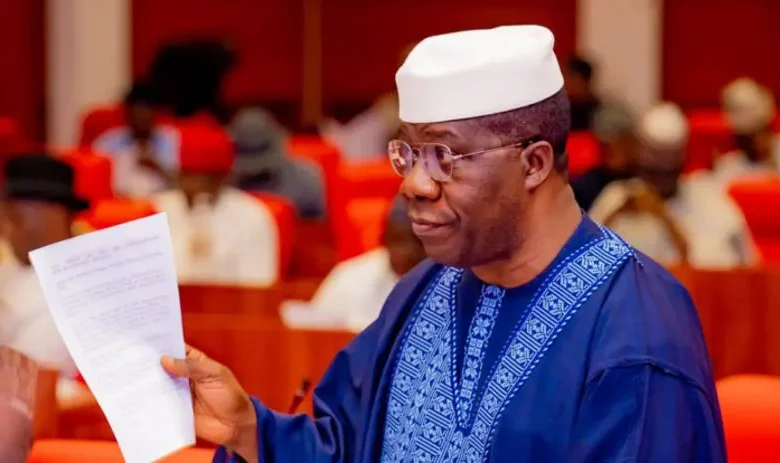
The decades-long debate surrounding the establishment of state police in Nigeria has finally crossed its most critical constitutional threshold, with Senate Leader Opeyemi Bamidele assuring that it will be ready on or before December 2026.
Our correspondent reports that no fewer than 30 State Houses of Assembly have officially approved the State Police Constitution Alteration Bill, 2026.

Speaking on the Bill on Thursday, the Leader of the Senate declared that multi-tier policing in Nigeria has moved from a recurring political promise into an actionable constitutional reality.

Bamidele, who also serves as the Vice Chairman of the Senate Committee on the Review of the 1999 Constitution, made the disclosure while delivering a paper at the National Institute for Policy and Strategic Studies (NIPSS), Kuru, Plateau State.

He addressed participants of the Senior Executive Course (SEC) 48 on the topic, “Improving the Efficiency and Effectiveness of Governance through Proactive Lawmaking.”

Highlighting the historic milestone, Bamidele explained that the 30 state approvals comfortably satisfy the two-thirds concurrency requirement mandated by Section 9(2) of the 1999 Constitution (as amended).
“We are pleased to inform our constituents across the federation that State Police have moved from rhetoric to reality,” Bamidele said. “By the provision of Section 9(2) of the 1999 Constitution, which requires the concurrence of not less than two-thirds of all State Houses of Assembly, the constitutional requirement for the alteration has been duly met.”
Outlining the next legislative steps, the Senate Leader revealed that the process is now procedural but vital.
According to him, the National Assembly will formally collate the reports from the state assemblies, pass a resolution by a simple majority in both chambers, and transmit the bill to the President for assent—a sequence scheduled for completion on or before December 2026.
Addressing concerns over potential misuse by state executive authorities, Bamidele emphasised that the reform is aimed at decentralised security, not creating political armies.
“It is not about creating state armies, but about creating state-led, community-anchored policing within clear constitutional safeguards, operational standards, oversight mechanisms, and human rights protections,” he noted, adding that the objective is to build a security framework that understands local terrain and communicates in local languages.
Daily Trust