

By Kayode Akinmade
An imposing edifice in the heart of Ijebu-Ode, designed as a central hub for presidential, gubernatorial and legislative campaigns, combines architectural elegance with a vision of accessible political representation.

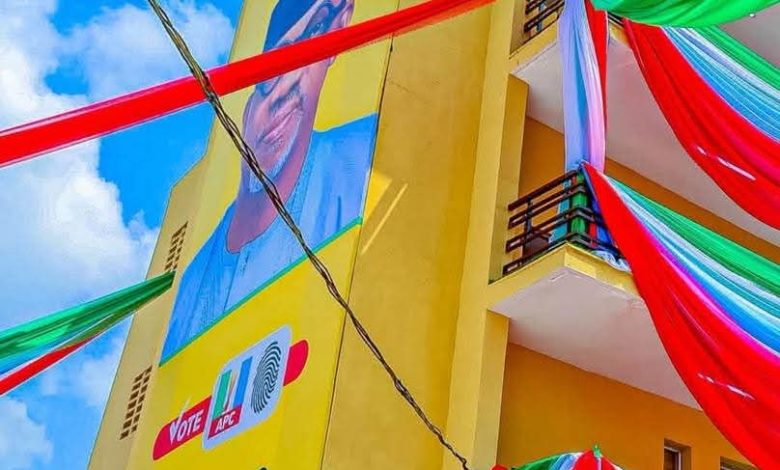
There was an unmistakable explosion of colour, culture, music and political excitement in Ijebu-Ode on Thursday, November 26, 2026, as Ogun State Governor, Prince Dapo Abiodun, CON, commissioned an impressive campaign office that is set to become a major political landmark and coordination centre in Ogun East Senatorial District.

It was more than a commissioning ceremony. It was a carnival of sorts, a celebration of political fellowship, cultural identity and collective aspirations, as traditional rulers, Baales, Olorituns, community leaders, market women, party chieftains, political associates and residents converged to witness the unveiling of an edifice that promises to redefine political organisation and constituency engagement in the district.

From the moment guests began arriving, the atmosphere was electrifying. Traditional and contemporary music filled the air, cultural rhythms blended with popular political songs, while spontaneous dancing, singing, applause and warm exchanges transformed the occasion into a colourful spectacle. The presence of representatives of the Hausa and Arewa political communities in Ijebuland further reflected the diversity and inclusiveness of the gathering.

But beyond the music, dancing and celebratory atmosphere, the magnificent building itself commanded considerable attention.
Strategically situated in the heart of Ijebu-Ode, the historic and commercial centre of Ijebuland, the imposing facility occupies a location that gives it both political significance and practical accessibility. Its position makes it a natural meeting point for political leaders, party stakeholders, community representatives and residents travelling from different parts of Ogun East.
Carefully put together under the initiative of Prince Dapo Abiodun, the beautiful edifice stands out as a statement of organisation, preparedness and a deliberate investment in the political and administrative infrastructure of the district.
Its spacious and well-organised interior, thoughtfully arranged administrative areas and comfortable meeting facilities provide an atmosphere suitable for consultations, strategic meetings, stakeholder engagements and official activities. It is a facility designed not simply to attract attention from the outside but to accommodate the demands of serious political organisation and public service.
Indeed, its significance extends beyond the senatorial ambition of its initiator.
The building is envisaged as a central campaign headquarters and coordination hub for the presidential, gubernatorial, senatorial, House of Representatives and House of Assembly campaigns in Ogun East Senatorial District. In this capacity, it will provide an organised platform for coordinating political activities, harmonising campaign strategies, engaging stakeholders and mobilising support across the district.
It is an ambitious concept that places the facility beyond the conventional campaign office, giving it the potential to become a permanent reference point for political coordination and stakeholder engagement in Ijebu and Remo.
In a district comprising several local government areas and communities with diverse interests, the importance of having a central, accessible and properly equipped facility cannot be overstated.
Abiodun, in his address, explained that the office would also function as a constituency resource centre, providing residents with a direct and accessible channel to communicate their needs, priorities, complaints and expectations.
He said the facility would serve not only his senatorial activities but also provide an engagement point for members of the National Assembly and other public officials whenever they visit the district.
The governor’s explanation gave the building a broader institutional significance. Rather than being a structure that would become dormant after an election, it is intended to remain a functional platform for public interaction, consultation and the coordination of constituency affairs.
Abiodun also used the occasion to demonstrate his readiness for the legislative responsibilities ahead, declaring that he would hit the ground running from his first day in the Senate if elected to represent Ogun East in the January 16, 2027 elections.
With the confidence of a man who has spent seven and a half years navigating the complexities of governance, he assured the people that he was prepared to bring his experience in public administration to bear on their representation.
Perhaps the most consequential declaration of the occasion was his unequivocal commitment to champion the creation of Ijebu-Remo State.
Addressing the enthusiastic gathering, Abiodun promised to take an active leadership role in mobilising support among senators, members of the House of Representatives and other relevant stakeholders to advance the long-standing aspiration of the Ijebu and Remo people.
“By the grace of God, when I get to the Senate, I will be at the vanguard of pursuing the creation of Ijebu-Remo State,” he declared.
He acknowledged that state creation was a constitutional process requiring legislative action, broad-based consultations and the fulfilment of stipulated requirements. Nevertheless, he expressed confidence in the viability of the proposed state, given the area’s rich human resources, economic potential and natural endowments.
His declaration immediately placed the Ijebu-Remo State project at the centre of his proposed legislative agenda, offering a clear indication of the issues he intends to pursue at the National Assembly.
The occasion also provided an opportunity to reflect on the development trajectory of Ogun East under the Abiodun administration.
The governor highlighted interventions across the senatorial district, particularly in road infrastructure, healthcare, education, electricity, water supply and rural development.
He disclosed that his administration had constructed 26 roads in Ijebu-Ode, describing the intervention as unprecedented. He also recalled road projects in Ogun Waterside, an area he said had not witnessed government road construction for 16 years before his administration intervened.
Other benefiting areas, according to him, include Ijebu North, Ijebu North East, Ijebu East, Odogbolu, Sagamu, Ikenne and Remo North.
He further highlighted the distribution of transformers, solar-powered streetlights, solar-powered boreholes and road graders to support communities and improve living conditions.
On social intervention, Abiodun disclosed that his administration had introduced a support scheme under which 10 beneficiaries in each polling unit received N15,000, with plans to increase the amount to N45,000. About 15,000 residents across Ogun East had benefited from the initiative.
The governor also spoke about the economic prospects of the district, particularly the proposed Ogun State Deep Sea Port in Ogun Waterside, describing it as a transformational project with enormous potential for maritime commerce, industrialisation, employment generation and investment.
The port, alongside other emerging economic opportunities, is expected to open a new chapter in the economic history of Ogun East and strengthen its position as a major investment destination.
Senator Lekan Mustapha, Director-General of the Presidential and Governorship Campaign Council, commended Abiodun’s efforts towards positioning Ogun State as an oil-producing state following discoveries in Ogun Waterside and other parts of Ijebuland.
He noted that the creation of a new state required legislative collaboration and constitutional procedures, stressing the importance of experienced representation at the National Assembly in advancing the aspiration.
Otunba Rotimi Paseda also acknowledged the administration’s development interventions, while the Chairman of the Ogun State Elders Advisory Council, Chief Olu Okuboyejo, expressed confidence in Abiodun’s capacity to represent the interests of the Ijebu and Remo people, drawing from his experience as governor.
Ultimately, Thursday’s commissioning was a convergence of political symbolism, architectural investment and a declaration of intent.
The building, standing prominently in the heart of Ijebu-Ode, represents more than bricks, concrete and administrative spaces. It is a proposed nerve centre for political coordination across Ogun East, a meeting point for stakeholders and a platform through which the aspirations and concerns of the people can be channelled.
There is an enduring distinction between erecting a building and creating an institution. A building provides an address; its purpose gives it relevance, while the services it delivers determine its lasting value.
For Prince Dapo Abiodun, the new edifice is an expression of preparedness for the political responsibilities ahead and an attempt to provide an organised structure through which political engagement and constituency administration can be sustained.
And for Ogun East, the significance of the facility may ultimately be measured not by the grandeur of its architecture or the splendour of its commissioning ceremony, but by how effectively it becomes a centre of coordination, consultation and service to the people.
In the colourful celebration that accompanied its unveiling, one message stood out: the political future of Ogun East is being given a new address in the heart of Ijebu-Ode.