

Certain desires may have informed Mary Wollstonecraft’s public opinion about women in Vindication of the Rights of Women (1792). The first motive may be linked to women as an oppressed class regardless of their social hierarchy. This may be situated within the purview that women lacked both political or legal rights and were often offered few opportunities for employment, and, if they married, must give their property to their husbands.
Within the sociological imperative of the West may be found the necessity for “feminism,” a movement, and a set of beliefs, that problematize gender inequality. Dickinson (2003) assumes that feminism is an intellectual and political commitment to women. Thus, feminism is belief in the equality of social, politics and economy for women.

Therefore, the struggle of women for equality harbors ample records of the European civilization as one rooted in patriarchal ideology.

Moreover, the Seneca Falls Convention of 1848 recorded this supposed and inconvenient development of women’s fight for equal rights in relation to gender and power dynamic. What may be known to the public today, however, is the accounts that the liberation of women from being oppressed by patriarchy economically, politically, socially, and psychologically only has origin in the Western clime.

Yet, records of the moments of women’s dignity and respect are also prevalent in Ifa rituals among Yoruba people of West Africa.

Ifa , a divination system, is practiced among Yoruba communities and by the African diaspora in the Americas and the Caribbean. The word Ifa refers to the mystical figure Ifa or Orunmila , regarded by the Yoruba as the deity of wisdom and intellectual development.
The ritual performance of Ifa is an honorable rite of passage within the Yoruba tradition and this process is called as Ìṣẹ́fá (partial initiation) or Ìtẹ́fá (full initiation).
The week-long ritual activities of Ifa requires the presence of an initiate who wishes to walk the path of Ifá and this blessed experience serves as a pivotal moment for deep transformation and spiritual cleansing. Also the initiate may be told to reframe from certain behaviors in order to live in alignment with his or her destiny.
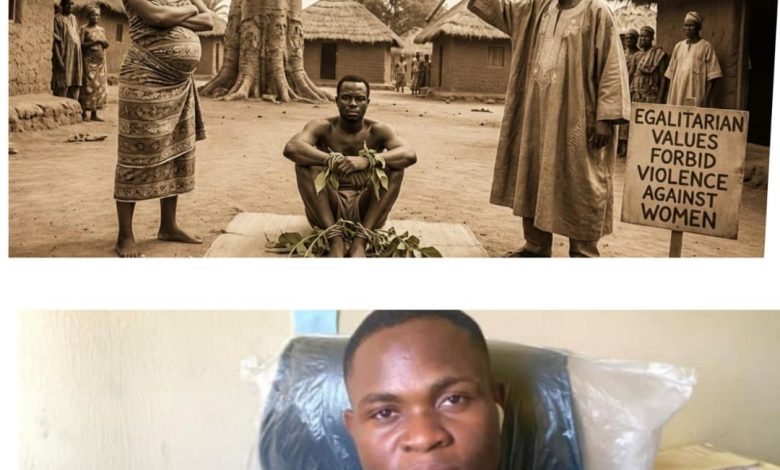
In Ifa ritual, feminist perspectives on women’s respect, dignity, and agency are reinforced. The most memorable of the performance is the one tagged where “men are beaten with a cane as a reminder of universal women rights and egalitarian values that forbid violence against women.” It is also brought to men’s notice that even when their wives become stubborn, men must never raise their hands to chastise or scold their wives.
A further culturally specific experience shared to the initiate is the consensus that a woman metaphorically carries the man’s own pregnancy, and her safety must be ensured. Therefore, Ifa teaches that women hold the secrets of the world. Women hold the success, honor, happiness of men and even the downfall of any person rest upon them. Women, in fact, influence the trajectory of noble warriors’ tragic flaws.
The teachings available in Ifa rituals are pointers to the Western concern for women’s liberation, self-reliance, and fight against patriarchal norms. Relics of these universalist warrants that allow women to challenge the power dynamics of patriarchy also dot every part of Yoruba metaphysics to show diverse experiences of people shaped by colonialism and provide insights toward a fair, all-in global knowledge system. What may be ascribed to this point is that the world’s awareness of current and ongoing feminist concerns about women’s struggle in West Africa and globally confirm that decolonial operations may equally illuminate actions for women’s agency.
Works Cited
Dickinson, Torry D. (2003). Community and the World: Participating in Social Change. New York: Nova Science Publishers, Inc.
Wollstonecraft, M. (1792). Vindication of the Rights of Woman. Penguin Classics.
Seun Sobola is a graduate student in the United States of America.